
Bellevue Hill Improvement Association

History & Preservation
A Community Shaped by Its Landscape
West Roxbury developed as a community distinct from Boston’s urban core, shaped by its rolling landscape, farms, country estates, and later residential growth. For much of its early history, the area retained a distinctly rural and agricultural character, with farming playing an important role in its development. By the early twentieth century, West Roxbury was being promoted as Boston’s “Garden Ward,” reflecting its spacious, green, and increasingly residential character.
Over time, improved transportation helped transform West Roxbury from a rural and agricultural landscape into a residential community. Rail service reached the area in the nineteenth century and contributed to its development as a residential suburb.
Understanding this history helps explain many of the characteristics that continue to distinguish West Roxbury today—and why documenting its historic landscapes, buildings, streets, and neighborhoods remains important.
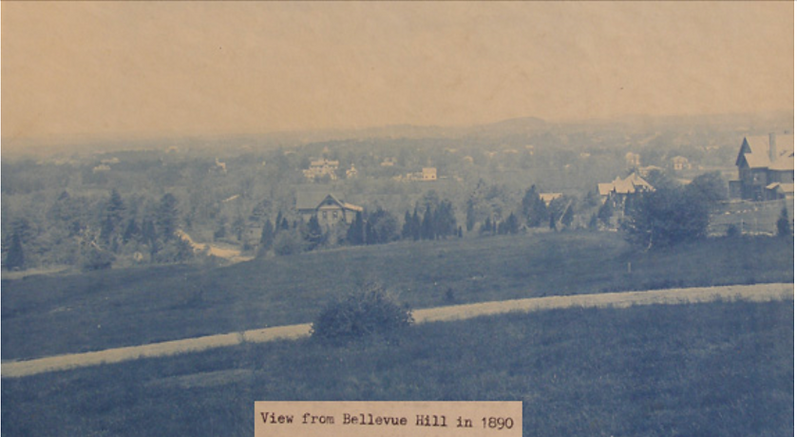
View from Bellevue Hill, 1890. Image previously published on the West Roxbury Historical Society website.
Preserving the Places That Tell Our Story
West Roxbury’s streets, homes, landscapes, and historic places reflect generations of growth and change in our community. As part of BHIA’s mission to preserve, protect, and improve West Roxbury, we believe that understanding and documenting this history is an important part of planning thoughtfully for its future.
BHIA works to research, share, and encourage recognition of the historic and architectural resources that contribute to the character and identity of our community.
Preservation Initiatives
BHIA researches and supports efforts to document and appropriately recognize historic resources within our community. As projects and initiatives develop, information and updates will be shared here.
Historic Maps & Resources
West Roxbury’s history can be found across historic maps, photographs, property records, surveys, newspapers, and archival collections. Many of these materials are held within larger Boston and Massachusetts collections and require some searching to uncover
MACRIS — Massachusetts Cultural Resource Information System
Search Massachusetts Historical Commission records for documented historic buildings, areas, districts, and other resources. MACRIS can be narrowed by city/town, neighborhood, street, address, architectural style, construction date, and other criteria.
Atlascope — Historic Boston Atlases
Compare historic property atlases with the present-day landscape. Atlascope allows you to search a modern address and overlay historic atlas maps, which makes it particularly useful for researching West Roxbury streets and individual properties.
West Roxbury By Map
The Leventhal Map & Education Center presented a program specifically exploring West Roxbury through historic maps, including neighborhood development and how residents can research the history of their own homes and neighborhoods.
Research Your Home
Historic maps, building permits, directories, and other public records can help reveal when a home was built, who lived there, and how a property and its surroundings developed over time.
Boston Historical Building Permits
Search City of Boston records for historical building permits and alterations associated with a property.
Massachusetts Land Records — Suffolk County Registry of Deeds
Search recorded deeds and other land records to research property ownership and the history of a parcel.
Preservation FAQs
Q: Does preservation mean BHIA is against all development?
A: No. Preservation and development are not mutually exclusive.
BHIA recognizes that communities grow and change over time and that thoughtful development can contribute positively to a neighborhood.
We believe change should be informed by an understanding of the history, character, built environment, and existing resources of the community, including meaningful civic discourse and community feedback. BHIA’s goal is not to prevent development, but to encourage informed, responsible decisions about how our community evolves.


